
Home
Home Assistant
Your house in one sentence, on the dashboard.
- Mark: Reviewed
- Mark: Starboard's own
- Version 1.1.4
At a glance
- Reviewed
- 23 November 2026, version 1.1.4
- Works with
- Jellyfin
- Plex
- Emby
- Starboard
- Needs Starboard 0.18 or later
- Memory use
- Memory use not measured yet
- On a test server
- About 12 MB of memory on a test server
What it does
Home Assistant asks your Home Assistant for the state of the things you choose and shows them in one sentence, such as Front door: closed. Lounge: 20.5 °C. It shows the first 8.
You can choose which states give a warning, such as open, on or unlocked. It only reads states and never changes anything in Home Assistant. The card updates once a minute while the dashboard is open.
Made by TheMightyTRexUK. Licence: MIT.
- home assistant
- smart home
- sensors
- door
- lock
- temperature
- home automation
- entities
- status
- iot
Who it is for
People who run Home Assistant and want a quick check on a door, a lock or a temperature from their media server dashboard.
What you will see
One dashboard card, Home, with the things you chose in one sentence. The status shows OK, Warning when one is in a state you chose, or Needs setting up. Its settings are the address, the token, What to show and Warn when any is.
Pictures

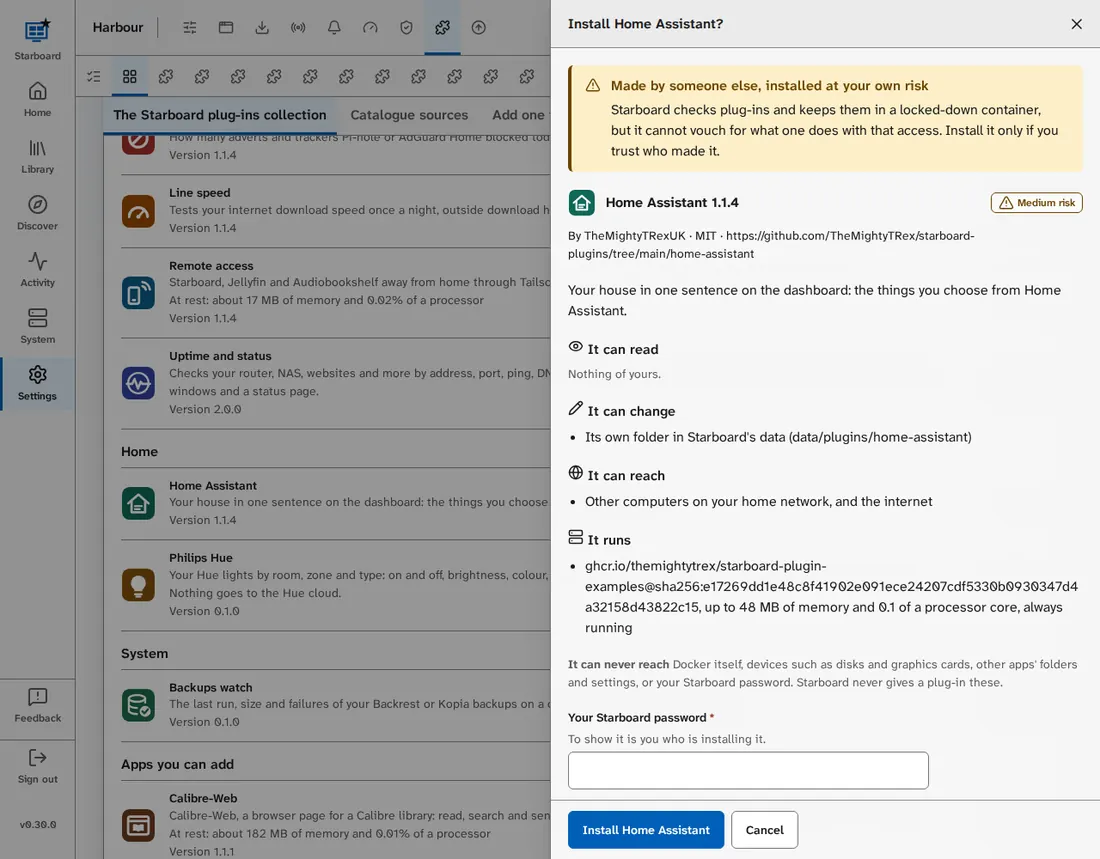
Real screenshots from a test copy of Starboard that holds made-up data only. Select a picture to open it full size.
What it can read and change
Starboard asks you before it gives a plug-in any of these. You can take one away later in Settings, then Plug-ins.
- Reads and changesTalk to things on your home network
Connects to apps and devices at home, and to the internet.
network:lan
It can read
- Talk to things on your home network
It can change
- Talk to things on your home network
What it needs
- Starboard
- Needs Starboard 0.18 or later. Its manifest asks for plug-in API 1.14 or later, up to but not including 2.0.
- Other apps
- Nothing else.
- In practice
- Home Assistant running on your home network, its address, and a long-lived access token made in your Home Assistant profile under Security. You also need the entity ids of the things to show.
- A web page
- No. It shows on the Starboard dashboard.
What it uses
Two kinds of figure appear here, and each row says which. Measured figures were read from a running plug-in. Declared figures are limits written in its manifest. Where nothing is measured, it says so.
| What | Figure | Kind | Note |
|---|---|---|---|
| Memory at rest | Not measured yet | Not measured | |
| Most memory seen | Not measured yet | Not measured | |
| Memory limit it is given | 48 MB | Declared | The most it may use before Docker stops it. |
| Processor at rest | Not measured yet | Not measured | |
| Processor limit | 0.1 of a core | Declared | |
| Image on disk, unpacked | Not measured yet | Not measured | |
| Disk for its own data | Not measured yet | Not measured | Its folder in Starboard's data. |
| Network | Your home network and the internet. | Declared | main: port 8080 |
| Containers | 1 (main) | Declared | |
| Runs | All the time | Declared | |
| Asks to read or change | 1 thing: the list above | Declared |
Nobody has measured this plug-in on a running server yet, so no memory or processor figure is shown. The limits marked Declared are what its manifest allows, not what it uses.
Measured on a test server
Measured on a test server with made-up data, 25 November 2026, Starboard 0.30.0. Machine: Linux x86_64, 12 cores, 16 GB memory. These are not figures from a real server.
| What | Figure |
|---|---|
| Memory use, idle after start | About 12 MB |
| Memory use, after it was used | About 12 MB |
| Processor, averaged over 60 seconds idle | About 0 % of one core |
| Image size, unpacked | About 62 MB |
| Containers | 1 |
Versions and notes
Version 1.1.4
Latest19 November 2026Changed
- Reaches Starboard on any network: with Starboard 0.23.0 or later it calls Starboard through a socket in its own folder, so it works on its own closed network too. An older Starboard works as before.
Version 1.1.3
17 November 2026Changed
- Clearer words: Warn when any is says the card gives a warning, not what colour it turns.
- Logo description: where its logo stands on its own, a screen reader says "Home Assistant logo", the plug-in's name, instead of a description of the symbol.
Version 1.1.2
17 November 2026Changed
- Shared helper: the helper every example shares sends Jellyfin's key the way Jellyfin 12 asks for it. This plug-in does not ask Jellyfin anything, so it works as before.
Version 1.1.1
16 November 2026Changed
- Lighter at rest: it wakes about once a minute while nothing asks it anything, not twice a second, and writes nothing to its folder when a run goes well.
- Starts faster: its image comes with Python's modules already compiled, so a start takes about a quarter of the processor time.
Version 1.1.0
15 November 2026Added
- A logo in Settings, Plug-ins, in the Catalogue and on its dashboard cards.
- Its cards say how things are: a status and when they last changed, in the grey band at the top of each card.
Changed
- Needs Starboard with plug-in API 1.14 or later. A Starboard with an older plug-in API keeps version 1.0.0.
Version 1.0.0
12 November 2026Added
- Your house in one sentence on the dashboard: the things you choose from Home Assistant.
Older versions Starboard can fall back to: 1.0.0.
Help
The plug-in help centre explains what Home Assistant does, how to set it up and what to do when it does not work.
How to install in Starboard
From Starboard
- In Starboard, open Settings, then Plug-ins, then Catalogue.
- Under Catalogue sources, paste
https://themightytrex.github.io/stallboard/catalogue.jsonand select Add catalogue. You do this once. - Find Home Assistant in the Catalogue and select Install. Starboard shows what it asks for, and you choose.
By address
Or give Starboard this plug-in's address: in Settings, then Plug-ins, then Catalogue, paste it under Add one from elsewhere.
https://raw.githubusercontent.com/TheMightyTRex/starboard-plugins/ef67f0c273140fd80637bd3b9c8feb7ed15b648f/home-assistant/starboard-plugin.json
Who reviewed it
Reviewed by TheMightyTRexUK on 23 November 2026, version 1.1.4. Listed on 23 November 2026. Its manifest was last read on 23 November 2026. What Reviewed means.
Report a problem with this plug-in
Something wrong with Home Assistant itself? Tell its maker. The report goes to the plug-in's own issue page, not to Stallboard.
Report a problem with this plug-in (opens in a new tab)
A problem with Stallboard, such as this page? Use the Send feedback button.
More in Home
-

Philips Hue
Home
Your Hue lights by room, with nothing sent to the cloud.
- Jellyfin
- Plex
- Emby
Needs Starboard 0.23 or later
Memory use not measured yet