
Network
Uptime and status
Check your router, NAS and websites, with a status page.
- Mark: Reviewed
- Mark: Starboard's own
- Version 2.0.0
At a glance
- Reviewed
- 23 November 2026, version 2.0.0
- Works with
- Jellyfin
- Plex
- Emby
- Starboard
- Needs Starboard 0.25 or later
- Memory use
- Memory use not measured yet
- On a test server
- About 16 MB of memory on a test server
What it does
Uptime and status checks the things you list, one line each: a web address, words on a page, a port, ping, a DNS record, a certificate, or a heartbeat that a backup or script calls. It says when each is down and sends an alert through Starboard.
It keeps 90 days of response times and uptime, with no database. Checks can be put in groups, with maintenance windows that pause their alerts. Its status page, on your home network, shows each check as up or down without showing addresses.
Made by TheMightyTRexUK. Licence: MIT.
- uptime
- monitor
- router
- nas
- website
- ping
- status page
- heartbeat
- certificate
- up or down
Who it is for
People who want to know quickly that a router, a NAS, a website, a certificate or a backup is still working, without checking each by hand.
What you will see
Five dashboard cards: All checks, Checks (the ones down first), Groups, Response times over 24 hours and Certificates with the days left. Its tab has Checks, Groups and maintenance, alert settings and an Open button for the status page.
Pictures

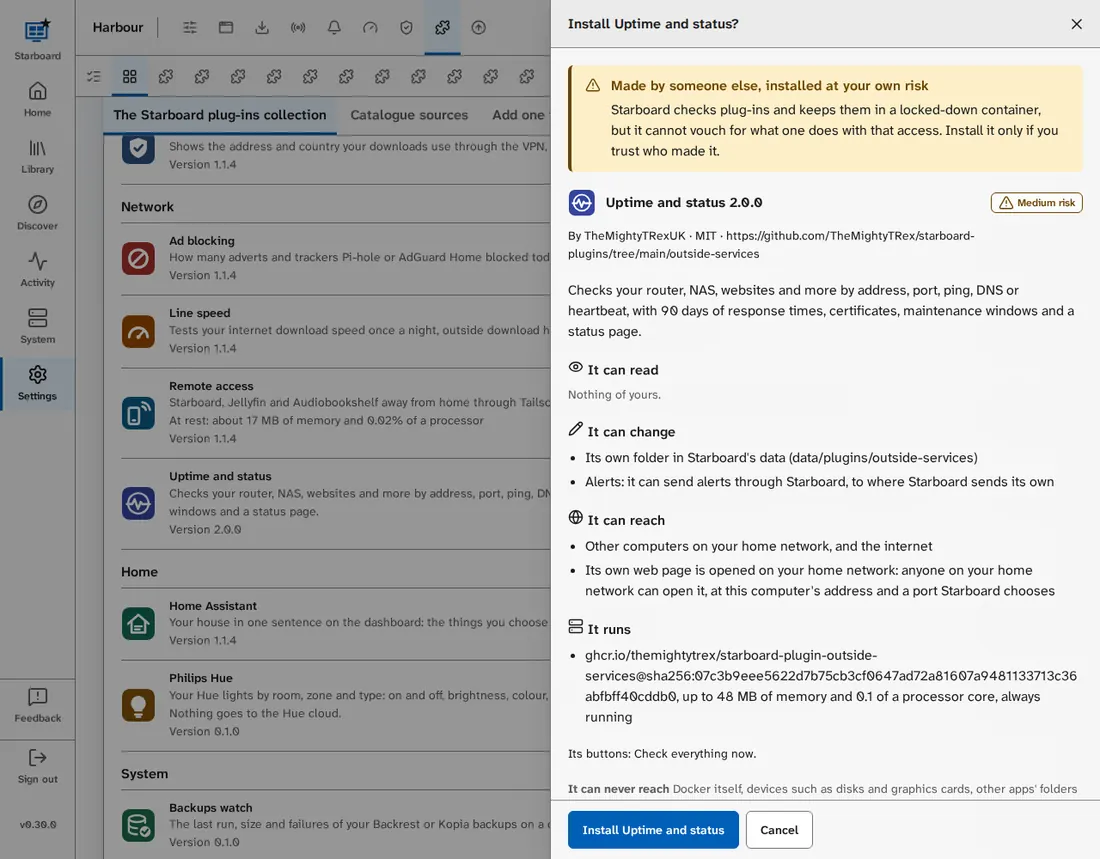
Real screenshots from a test copy of Starboard that holds made-up data only. Select a picture to open it full size.
What it can read and change
Starboard asks you before it gives a plug-in any of these. You can take one away later in Settings, then Plug-ins.
- Reads and changesTalk to things on your home network
Connects to apps and devices at home, and to the internet.
network:lan - ChangesOpen its own web page
Gives the app a page on your server, which you open in a browser.
network:port - ChangesSend alerts
Adds alerts to Starboard when something needs you.
alerts:send
It can read
- Talk to things on your home network
It can change
- Talk to things on your home network
- Open its own web page
- Send alerts
What it needs
- Starboard
- Needs Starboard 0.25 or later. Its manifest asks for plug-in API 1.17 or later, up to but not including 2.0.
- Other apps
- Nothing else.
- In practice
- Starboard with plug-in API 1.17 or later. An older Starboard is offered Outside services 1.1.4, which checks web addresses only. You write the checks yourself, in Settings, Plug-ins, Uptime and status, Checks.
- A web page
- It opens its own page on your server.
What it uses
Two kinds of figure appear here, and each row says which. Measured figures were read from a running plug-in. Declared figures are limits written in its manifest. Where nothing is measured, it says so.
| What | Figure | Kind | Note |
|---|---|---|---|
| Memory at rest | Not measured yet | Not measured | |
| Most memory seen | Not measured yet | Not measured | |
| Memory limit it is given | 48 MB | Declared | The most it may use before Docker stops it. |
| Processor at rest | Not measured yet | Not measured | |
| Processor limit | 0.1 of a core | Declared | |
| Image on disk, unpacked | Not measured yet | Not measured | |
| Disk for its own data | Not measured yet | Not measured | Its folder in Starboard's data. |
| Network | Your home network and the internet. Opens its own web page on your home network. | Declared | main: port 8080 |
| Containers | 1 (main) | Declared | |
| Runs | All the time | Declared | |
| Asks to read or change | 3 things: the list above | Declared |
Nobody has measured this plug-in on a running server yet, so no memory or processor figure is shown. The limits marked Declared are what its manifest allows, not what it uses.
Measured on a test server
Measured on a test server with made-up data, 25 November 2026, Starboard 0.30.0. Machine: Linux x86_64, 12 cores, 16 GB memory. These are not figures from a real server.
| What | Figure |
|---|---|
| Memory use, idle after start | About 16 MB |
| Memory use, after it was used | About 16 MB |
| Processor, averaged over 60 seconds idle | About 0 % of one core |
| Image size, unpacked | About 62 MB |
| Containers | 1 |
Versions and notes
Version 2.0.0
Latest20 November 2026Added
- More kinds of check: a port (tcp), ping (with a knock on common ports where ping is not allowed), a DNS record, and words on a web page (keyword), beside web addresses.
- Heartbeats: a push check gives an address for a backup or a script to call; no call within its grace time means down.
- 90 days of history: response times and uptime an hour and a day, about 43 KB a check, with no database.
- Certificates for every https address and every port checked with tls: the days left and the names it was issued for.
- Groups, tags and maintenance windows: write in Home after a check; a group's alerts pause in its maintenance windows.
- Alerts through Starboard, to where it sends its own, once when a check is down and once when it is up again.
- A status page on your home network, which only shows names, up or down, response times and uptime.
- Three more cards: Groups, Response times (a small line for each check) and Certificates.
Changed
- Outside services is now Uptime and status. Your Addresses to check and Check every stay as they were and are checked as before, in the group Outside services.
- Needs Starboard with plug-in API 1.17 or later, for the Response times card and the alerts. A Starboard with an older plug-in API keeps version 1.1.4.
- Its own image, with the status page's files, in place of the image the examples share.
Version 1.1.4
19 November 2026Changed
- Reaches Starboard on any network: with Starboard 0.23.0 or later it calls Starboard through a socket in its own folder, so it works on its own closed network too. An older Starboard works as before.
Version 1.1.3
17 November 2026Changed
- Clearer words: the band says Not answering, and the card names each one. Its description spells out NAS.
- Logo description: where its logo stands on its own, a screen reader says "Outside services logo", the plug-in's name, instead of a description of the symbol.
Version 1.1.2
17 November 2026Changed
- Shared helper: the helper every example shares sends Jellyfin's key the way Jellyfin 12 asks for it. This plug-in does not ask Jellyfin anything, so it works as before.
Version 1.1.1
16 November 2026Changed
- Lighter at rest: it wakes about once a minute while nothing asks it anything, not twice a second, and writes nothing to its folder when a run goes well.
- Starts faster: its image comes with Python's modules already compiled, so a start takes about a quarter of the processor time.
Version 1.1.0
15 November 2026Added
- A logo in Settings, Plug-ins, in the Catalogue and on its dashboard cards.
- Its cards say how things are: a status and when they last changed, in the grey band at the top of each card.
Changed
- Needs Starboard with plug-in API 1.14 or later. A Starboard with an older plug-in API keeps version 1.0.0.
Version 1.0.0
12 November 2026Added
- Up or down for things that are not on this server: your router, a NAS (network storage device), a website.
Older versions Starboard can fall back to: 1.1.4, 1.0.0.
Help
The plug-in help centre explains what Uptime and status does, how to set it up and what to do when it does not work.
How to install in Starboard
From Starboard
- In Starboard, open Settings, then Plug-ins, then Catalogue.
- Under Catalogue sources, paste
https://themightytrex.github.io/stallboard/catalogue.jsonand select Add catalogue. You do this once. - Find Uptime and status in the Catalogue and select Install. Starboard shows what it asks for, and you choose.
By address
Or give Starboard this plug-in's address: in Settings, then Plug-ins, then Catalogue, paste it under Add one from elsewhere.
https://raw.githubusercontent.com/TheMightyTRex/starboard-plugins/ef67f0c273140fd80637bd3b9c8feb7ed15b648f/outside-services/starboard-plugin.json
Who reviewed it
Reviewed by TheMightyTRexUK on 23 November 2026, version 2.0.0. Listed on 23 November 2026. Its manifest was last read on 23 November 2026. What Reviewed means.
Report a problem with this plug-in
Something wrong with Uptime and status itself? Tell its maker. The report goes to the plug-in's own issue page, not to Stallboard.
Report a problem with this plug-in (opens in a new tab)
A problem with Stallboard, such as this page? Use the Send feedback button.
More in Network
-

Ad blocking
Network
How many adverts and trackers were blocked today.
- Jellyfin
- Plex
- Emby
Needs Starboard 0.18 or later
Memory use not measured yet
-

Line speed
Network
A nightly internet speed test, kept for a week.
- Jellyfin
- Plex
- Emby
Needs Starboard 0.18 or later
Memory use not measured yet
-

Remote access
Network
Reach Starboard and Jellyfin away from home, safely.
- Jellyfin
- Plex
- Emby
Needs Starboard 0.18 or later
About 17 MB of memory at rest